Ambiguity, indecisiveness, and indifference are not words any veteran wants associated with them. The ability to be decisive, rational, and assertive are traits exalted in American society, forged and reinforced through years of military culture and doctrine. And yet there is a prevalence within our veteran community whose daily interactions exhibit exactly the former, while they deeply desire to be the latter.
That gap is not a character flaw. It may be a brain injury nobody documented.
Newsome and colleagues, writing in Military Medicine, examined decision-making in post-9/11 veterans with blast-related mild TBI and comorbid PTSD. What they found was striking. Veterans with this presentation made decisions without incorporating context at all. Not occasionally. Consistently. Their performance mirrored that of patients with severe TBI and left frontal lobe lesions. Not mild injury behavior. Severe injury behavior. In men and women whose injuries were classified as mild, on average four years after the fact, and in many cases never formally documented at the time they occurred.
Context-dependent decision-making is not a narrow cognitive function. It is the architecture of everyday life. Reading a room. Understanding what a conversation actually means. Knowing when to push and when to hold, the difference between staying employed…or not. Maintaining a relationship…or not. When this interaction of systems breaks down, the behavioral fallout looks like impulsivity, poor judgment and emotional dysregulation. It gets routed through psychiatric frameworks because there is no structural finding to attach anything else to. The veteran gets a label (and probably some drugs from the doc). The injury stays invisible.
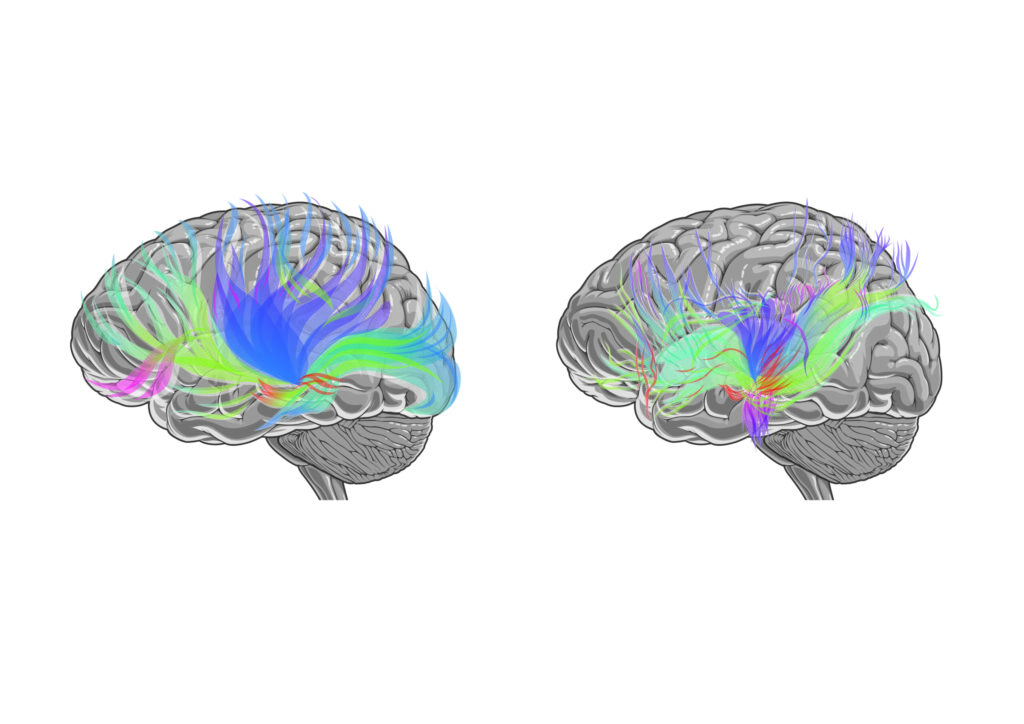
This is where the neuroscience gives us clues. The prefrontal cortex governs impulse regulation and the ability to pause before acting. The hippocampus encodes context and relational memory. Dennis and colleagues, in a large-scale neuroimaging study of over 2,500 veterans and active duty service members published in Human Brain Mapping, found altered microstructure in the left cingulum after blast mTBI, a white matter tract connecting prefrontal and hippocampal regions, with changes correlating directly with executive function performance. These are not abstract findings. They explain why a veteran who can articulate right from wrong still makes decisions that cost him his marriage, his job, or his freedom. His moral compass is intact. His map is damaged.
Edwards and colleagues, writing in Brain Impairment, are worth noting here precisely because of what they did not find. Testing moral decision-making in adults with moderate-severe TBI, they found no significant shift in moral reasoning compared to neurotypical controls. The TBI group’s performance was indistinguishable from healthy peers. Moral reasoning, it appears, is more resilient than the contextual processing that supports everyday decisions. These veterans are not making decisions without conscience. They are making decisions without the cognitive scaffolding that allows context to inform the choice. These are not good people gone bad. These are people laboring under the cumulative effects of choices they made to serve, and not having a support system around them that understands or can resolve the disequilibrium.
Chris May, a retired Marine Recon veteran and INVICTA Director, has said that his most important weapon was never a firearm. It was a map. Without it, everything else becomes guesswork. Position, direction, threat, objective. The map is what allows a decision to mean something. Consider that the brain of the veteran sitting across from you may be operating under the same constraint: a map that is fragmented, with large sections missing or corrupted. Not lost entirely. Fragmented. Enough to move. Not enough to navigate with confidence. The decisions still get made. They just get made without the full picture of where he is, what the terrain ahead looks like, or how the last move affected his position. That is not indecisiveness. That is dead reckoning.
The clinical implication is direct. The cognitive sub-processes disrupted in this population are not abstract. They are measurable, and they map onto real brain networks we understand reasonably well.
When these systems are compromised, the effects are stark and impactful. In everyday life they look like this:
- Cannot track the thread of a conversation long enough to respond appropriately
- Misreads a social situation and reacts to a threat that was not there
- Knows the right decision in the abstract but cannot execute it in the moment
- Loses employment not from lack of effort but because planning and sequencing have become genuinely difficult
- Watches a relationship deteriorate without understanding why
These are not personality failures. They are network failures. And networks can be assessed.
The framework exists. The tools exist. What does not exist is the clinical will to apply them systematically to a population we already know is at risk.
In Scotland we say that still waters run deep. Giving a person back their life, their identity, their independence and autonomy has to consider all executive functions. It cannot simply muddy already murky waters with a siloed, dismissive, psychiatric-centric viewpoint. The veteran sitting across from you who cannot make a decision is not indifferent to his own life. He may be navigating it with a system that was damaged before anyone thought to look.
That is not a psychiatric problem. That is a brain injury problem. And it deserves to be treated like one.
References
Newsome MR, de Souza NL, Avci G, et al. Making Decisions in Context in Post-9/11 Veterans with Comorbid Chronic Blast Mild Traumatic Brain Injury and Posttraumatic Stress Disorder. Military Medicine. 2026.
Edwards M, Morrow EL, Duff MC. Intact moral decision-making in adults with moderate-severe traumatic brain injury. Brain Impairment. 2023;24(3):568–585.
Dennis EL, Newsome MR, Lindsey HM, et al. Altered lateralization of the cingulum in deployment-related traumatic brain injury: An ENIGMA military-relevant brain injury study. Human Brain Mapping.